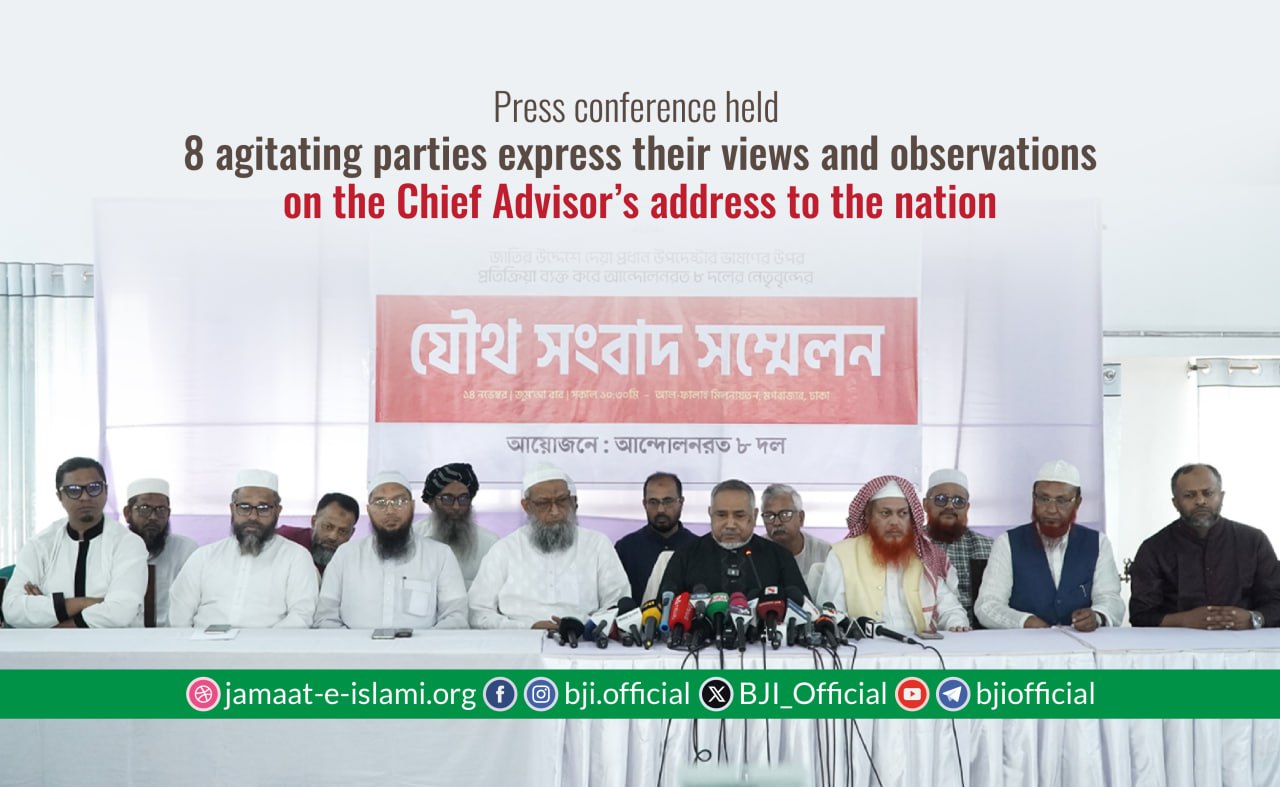
A joint press conference of the eight agitating parties was held on 14 November (Friday) at 10:30 AM, at the Al-Falah Auditorium in Moghbazar, Dhaka. The statements presented at the press conference reflected the views of the eight agitating parties on the address delivered by the Honorable Chief Advisor on 13 November. On behalf of the eight parties, Bangladesh Jamaat-e-Islami’s Nayeb-e-Ameer and former MP Dr. Syed Abdullah Muhammad Taher delivered a statement to journalists and responded to various questions.
Bangladesh Jamaat-e-Islami’s Assistant Secretary General Maulana Abdul Halim; Central Executive Council member and Secretary of the Central Publicity and Media Department, Advocate Matiur Rahman Akanda; Islami Andolan Bangladesh’s Joint Secretary General Hafiz Maulana Sheikh Fazle Bari Masud and Office Secretary Maulana Lokman Hossain Jafri; Bangladesh Khelafat Majlis’ Senior Nayeb-e-Ameer Maulana Yusuf Ashraf, Joint Secretary General Maulana Tofazzal Hossain Miyaji and Finance Secretary Maulana Fazlur Rahman; Khelafat Majlis’ Senior Nayeb-e-Ameer Maulana Sakhawat Hossain and Joint Secretary General Mr. Abdul Jalil; Bangladesh Nezam-e-Islam Party’s Secretary General Maulana Musa bin Izhar Chowdhury and Finance Secretary Md. Anwarul Kabir; Bangladesh Khelafat Andolan’s Secretary General Muhammad Yusuf Sadiq Haqqani and Secretary for Industry and Commerce Maulana Mohammad Touhiduzzaman; Jatiya Ganatantrik Party’s Vice-President and party spokesperson (JAGPA) Engineer Rashed Pradhan and General Secretary Profes
In his statement at the press conference, Dr. Syed Abdullah Muhammad Taher said, “It is our misfortune that in last 54 years history of Bangladesh, governments have changed repeatedly, systems of governance have changed, but exploitation has never stopped. The failure of leadership is the greatest disgrace. We had hoped that after the second independence, or the July Revolution—earned through immense blood and sacrifice—there would be a stable administration in this country, a sound political environment, guaranteed human rights, a fair democratic process, people-friendly good governance, a desire for democracy, a corruption-free Bangladesh, and above all, a change of government through a neutral, free, and spontaneous election with people’s full participation.
“The interim government began its journey based on three fundamental issues. As you know, the Chief Advisor made a promise to the nation with clear statements on these three issues. One was to undertake comprehensive reforms that would ensure good governance in the days ahead. Another was to ensure visible trials for those involved in genocide. And the third was to arrange a free and fair election.”
He further said, “The Reform Commission, consisting of 31 parties, spent valuable time and reached consensus on many important matters, which they also signed. The nation, filled with joy and hope, was preparing for the election. Based on the reforms we had signed, we were taking preperation for a proper election. Suddenly, one party expressed disagreement on the question of reforms. From the beginning, they had shown an attitude that they did not want reforms.”
He said, “On 13 November, we were astonished to see that, instead of accepting the Reform Commission’s recommendations, the Chief Advisor delivered his speech by compromising with one party and making many changes in favor of that specific party while ignoring the interests of the people. As a result, the public and the nation have become deeply disappointed. However, we thank Dr. Muhammad Yunus for giving constitutional legitimacy to the July Charter through a formal order. But several changes were made in the Charter from the structure, which had originally been proposed by the Reform Commission. We do not consider this correct. We believe that it would have been appropriate to issue the order exactly on the basis of the Reform Commission’s proposal. Even then, we have accepted the order to the extent it has been issued, and for that we appreciate him.”
He continued, “The Reform Commission had recommended a yes-no vote to acquire a public mandate for full reforms. But the government, by dividing the Reform Commission’s recommendations into four parts and proposing a referendum on each, has placed people in great complexity. Voters will find it difficult to analyze each point and decide their opinion, leading to complications.
“The government has divided the yes-no votes into four sections only to accommodate BNP’s note of dissent. The nation believes this is against the law and against the establishment of justice.”
He added, “The Consensus Commission had stated earlier that, whoever is elected and forms the government must constitutionally incorporate these within 180 working days. And if they fail, it will automatically be considered adopted. But the Chief Advisor’s announcement did not include this binding provision. Through this, BNP’s demand has been fulfilled.”
He further said, “We saw that the government clearly stated that the national election and the referendum will be held on the same day. The entire nation wanted the referendum to be held separately. If the referendum is held beforehand, then even 80% of people may go against their own thought process. This may be considered a referendum against one party before the election. Fearing this, BNP has said they will never accept the referendum if it is held before the election. The government accepted this demand and announced that the referendum and the national election would be held on the same day.”
“We (the 8 parties) represent the majority of the population. The referendum is about the issue of reforms and the national election is about forming the government—these are two entirely different matters. If the referendum is held on the same day, the issue of reforms will become insignificant. Each party will focus on building public opinion for votes on their respective symbols. Therefore, if voting occurs on the same day, the yes-no vote will become meaningless, and very few will show interest in participating in it. Instead, each party will try to persuade the public in favor of their own position. As a result, the yes-no vote will be minimized and become insignificant.
If due to lack of public attention the yes-no vote turnout becomes low, then those who do not want reforms will raise questions, arguing that the public did not want it—and they will withdraw from reforms. Therefore, we consider this a trap. And unfortunately—whether knowingly, unknowingly, intentionally, or because of deception—the government appears to have fallen into the trap of one party and has made the reform process almost insignificant. Previously too, we saw this government displaying loyalty or weakness toward that party in many ways. That began with announcing the election date from London.”
He further said, “By announcing the Election Commission’s roadmap without consulting all parties, and through their repeated behavior of giving greater importance to one party’s demands, it has become apparent to the nation that this government is no longer neutral. We believe this government is loyal to one party or is making efforts to hold an election—by any means necessary—to bring that party to power. Today, I clearly want to say that three advisors are misleading the Chief Advisor in various ways. They are providing incorrect information and manipulating the government to prevent a fair election, working skillfully on behalf of one party.”
“At this moment, we want to make a clear declaration: We are firmly committed to holding a national election before Ramadan in the coming February. For this reason, we are working on the ground to complete all preparations. But the same concerns have arisen among the public and us—whether another rehearsal of a controlled election is underway, whether an election based on a predetermined verdict is being planned, just as it happened during the 15 years of Awami League rule, when people were deprived of voting rights, and which has led to the disastrous state of Bangladesh today. The government’s behavior has compelled us to believe that a free and fair election is not possible under this government. On the contrary, we fear that the election will not be free, and we have lost confidence.”
He said, “The government is not focused on creating a level playing field. Rather, with the help of some advisors, efforts are underway to transform the administration into a partisan one in favor of a particular party. You already know that some changes have taken place, and efforts are being made to appoint individuals loyal to one specific party. Those in the administration who were humane and honest are being labeled and removed from important positions. If the situation continues like this until the election, there will be no environment for a fair election. If another election becomes unfair and unacceptable, an even greater disaster and a dark future await the country—there is no doubt about this.”
The three demands he placed before the government are:
One: The Chief Advisor must withdraw the announcement of holding the national election and referendum on the same day and immediately declare a separate date for the referendum—this is our demand.
Two: There are at least three advisors who are misleading the government. We demand their removal. We will provide their names to the Chief Advisor. If no action is taken even after that, we will consider making their names public.
Three: In places where changes are made in the administration, only neutral individuals—especially those who are honest and accountable—must be appointed. And efforts must be made to ensure neutral conduct.
“Today, protest programs were scheduled in Dhaka and across the country. The protest program in Dhaka has been replaced by this press conference. Outside Dhaka, the protest programs are continuing as scheduled and will continue until this evening, Insha Allah.”